Professional bakers treat measuring as a way to control ingredient ratios, not merely a way to fill a cup. In practical terms, they weigh ingredients—especially flour—use a consistent method for liquids, and account for how temperature and technique affect what goes into a recipe. King Arthur Baking notes that a cup of all-purpose flour can weigh about 120 grams, while a cup filled by scooping directly from the flour container may weigh more. That difference can make dough drier and baked goods denser. Understanding weight, volume, measurement technique, and recipe scaling helps explain why professional formulas are repeatable—and how home cooks can get more reliable results.
Baking measurement controls ingredient ratios
A baking measurement is a quantified amount of an ingredient used to produce a particular formula. The American Institute of Baking describes baking as a process in which ingredient proportions and processing conditions influence the finished product. In professional kitchens, recipes are commonly organized by weight because mass can be measured more consistently than volume. Home recipes often use cups and spoons, so the measuring method matters.
The distinction is consequential: a cup is a unit of volume, while a gram is a unit of mass. How much flour fits into a cup depends on its particle size, how it has settled, and whether it was spooned or scooped. King Arthur Baking’s reference weight of about 120 grams per cup of all-purpose flour is a useful conversion, but the recipe’s own stated weight should take precedence. Different ingredients—and even different flour types—do not share the same grams-per-cup value.
Weight measurement makes formulas repeatable
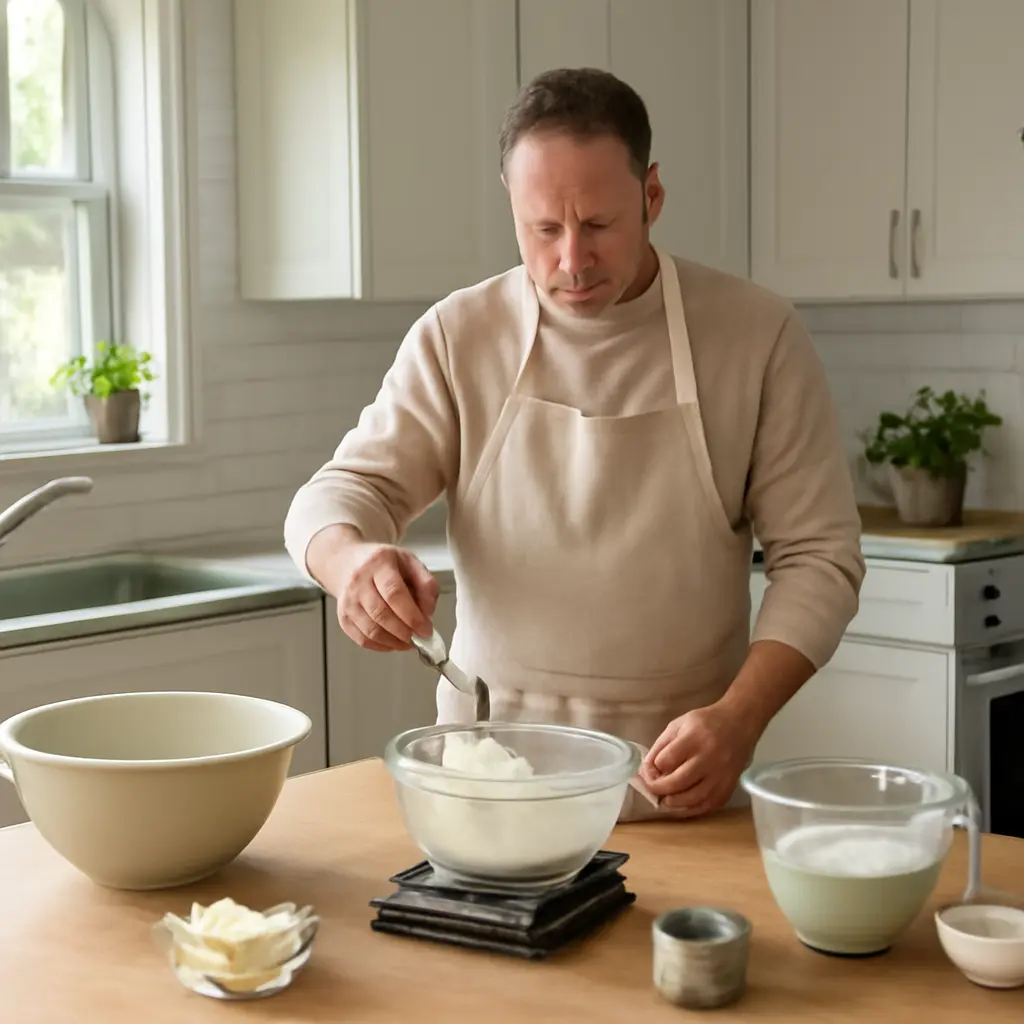
Weight measurement records an ingredient’s mass, typically in grams or kilograms. A digital kitchen scale lets a baker add ingredients directly to a bowl and reset the display between additions. Unlike a volume measure, the result is not changed by whether a powder is packed down or loosely settled.
For example, if a recipe calls for 360 grams of flour, weighing that amount avoids the uncertainty of converting the instruction into cups. This is particularly useful for bread, where flour and water proportions affect dough consistency. A scale does not eliminate every variable—flour moisture and room conditions still matter—but it removes a common source of avoidable variation.
Volume measurement depends on technique
Volume measurement uses the space an ingredient occupies, usually in cups, tablespoons, or teaspoons. It remains practical for many home recipes, but dry ingredients should be measured with a consistent method. For flour, King Arthur Baking recommends gently aerating or fluffing it, spooning it into the measuring cup, and leveling the top rather than dipping the cup into the bag.
Scooping can compress flour into the cup, increasing the amount beyond what a recipe writer intended. That extra flour can make cookies less tender or bread dough stiffer. Liquid ingredients require a different approach: use a transparent liquid measuring cup on a level surface and read the measurement at eye level. Nested dry cups are designed to be filled and leveled, not used as a substitute for a liquid jug.
Once the measurement system is clear, the next professional habit is choosing the right tool for each ingredient.
Bakers choose tools and methods to suit ingredients
A measuring tool is an instrument selected to quantify an ingredient accurately and conveniently. Professional practice distinguishes among scales, dry measuring cups, liquid measuring vessels, and small spoons because ingredients behave differently. The goal is not to own specialized equipment for its own sake; it is to make the measurement method match the recipe and ingredient.
Scales and tare functions
A kitchen scale measures mass, and its tare function resets the display to zero after a bowl or an ingredient has been placed on it. This allows ingredients to be weighed in one container without calculating the container’s weight. Bakers can also use the scale to portion dough into equal pieces, helping loaves, rolls, or cookies bake more evenly.
For useful results, place the scale on a stable, level surface, check that it is set to the requested unit, and avoid exceeding its capacity. If a recipe gives both weight and volume, use the weight when available—but follow the recipe’s specific ingredient weight rather than assuming every published conversion is identical.
Measuring flour, sugar, and other dry ingredients
Dry ingredients are powders or granules measured by weight or by dry-volume measures. Flour is especially sensitive to packing, while granulated sugar usually settles less dramatically. Brown sugar is a notable exception: many recipes explicitly call for it to be packed, so the baker should follow that instruction rather than applying the loose-fill method used for flour.
Small quantities of baking powder, baking soda, salt, and spices are typically measured with standardized measuring spoons. Leveling these spoons helps avoid an accidental excess. That matters because leaveners influence gas production and rise, while salt affects flavor and, in yeast doughs, fermentation behavior. When a recipe specifies a weight for a small ingredient, a sufficiently precise scale can reduce spoon-measurement variation.
Measuring liquids and sticky ingredients
Liquid measurement quantifies ingredients such as water, milk, oil, and syrup. For water-like liquids, a liquid measuring cup should be set on a flat surface and read at eye level at the appropriate line. Looking down at the cup can distort the reading through parallax—the apparent shift in a level when viewed from an angle.
Sticky ingredients such as honey or molasses can cling to measuring cups and spoons, leaving some of the recipe behind. Weighing them directly into the mixing bowl can make the amount easier to control and reduce cleanup. If using volume, lightly coating the measure with oil may help the ingredient release, provided that added oil will not affect the formula.
Even accurate tools cannot produce consistent results if recipes are scaled or interpreted without regard to their underlying proportions.
Recipe ratios and scaling preserve baking outcomes
A recipe ratio expresses the relationship between ingredients, often by weight. In the baker’s-percentage system, flour is conventionally set at 100 percent, and other ingredients are expressed as a percentage of the flour’s weight. For example, a dough with 1,000 grams of flour and 700 grams of water has a hydration of 70 percent. The method helps bakers compare formulas and scale a batch while preserving its proportions.
Baker’s percentages clarify dough formulas
Baker’s percentage is a formula notation in which each ingredient’s weight is divided by the flour weight and multiplied by 100. If a formula uses 20 grams of salt with 1,000 grams of flour, the salt level is 2 percent. Because every ingredient is related to the flour baseline, the formula can be enlarged or reduced without relying on ambiguous cup conversions.
The system is especially useful for bread, pizza dough, and other products where dough feel and fermentation depend on ingredient proportions. It does not mean that every baker uses the same formula: flour absorption, desired texture, and production conditions differ. Rather, it gives the baker a clear way to describe and reproduce a formula.
Scaling a recipe requires more than multiplying ingredients
Recipe scaling adjusts ingredient quantities to produce a different batch size. For many formulas, multiplying each ingredient by the same factor is a sensible starting point. Yet baking time, pan dimensions, mixing capacity, and heat transfer do not necessarily scale in the same way as ingredient weights.
A doubled cake batter may need to be divided between pans rather than baked in one deeper pan, because the center of a deeper cake heats more slowly. A large dough batch may also require a mixer with sufficient capacity and adjustments to mixing or fermentation. Professional bakers therefore use weights to scale the formula, then judge the equipment and process separately.
Temperature and ingredient condition affect measurement
Measurement is only one part of formula control: ingredient temperature and condition can change how ingredients behave during mixing. Butter measured cold, softened, or melted may have the same mass but performs differently in a recipe. Similarly, eggs vary in size, which is why professional formulas may specify their weight after cracking rather than rely only on a count.
The U.S. Department of Agriculture’s FoodData Central provides food-composition information, but a nutritional database is not a substitute for a recipe’s process instructions. Bakers should follow directions for ingredient state—such as softened butter or room-temperature eggs—because those instructions affect creaming, emulsification, and dough structure.
These principles become most visible in everyday baking, where a small measuring change can produce a noticeable difference in the finished food.
Consistent measuring improves real-world baking
Consistency is the ability to obtain similar results when the same formula and process are repeated. Professional bakeries rely on standardized recipes and repeatable methods because products must meet expectations across batches. Home cooks can apply the same logic without commercial equipment: use the same scale, weighing units, ingredient preparation, and mixing sequence each time.
Example: diagnosing dry cookie dough
Suppose a cookie dough repeatedly comes out crumbly, even though the recipe is followed. One useful check is how the flour is measured. If the cup is dipped directly into the bag, the flour may be packed more tightly than a spooned-and-leveled cup. Weighing the flour to the recipe’s specified gram amount can test whether excess flour is contributing to the problem.
Other causes remain possible, including too much flour in the original formula, inaccurate oven temperature, or butter at the wrong temperature. The professional approach is to change one variable at a time and record the result, rather than changing flour, mixing, and baking conditions all at once.
Example: portioning bread dough evenly
When dividing dough for rolls, weighing each portion helps keep pieces similar in size. Uniform portions are more likely to proof and bake at comparable rates, while visually estimated pieces can vary. A baker can weigh the full dough, divide the total by the desired number of portions, and use the scale to guide each cut.
This method is also useful for comparing test batches. If each loaf uses the same flour and water weights, differences in rise or crumb are easier to trace to fermentation, shaping, or baking rather than uncertain measuring.
A practical home-baking checklist
- Use a digital scale for flour and other ingredients whenever the recipe provides weights.
- For flour measured by volume, spoon it into the cup and level it; do not scoop directly from the container.
- Measure liquids in a liquid measuring cup on a level surface, reading at eye height.
- Follow ingredient-state instructions, including whether butter should be cold, softened, or melted.
- Use the recipe’s own conversions and specified methods instead of assuming one cup-to-gram value applies to every ingredient.
- When troubleshooting, change one measurement or process variable at a time and note the outcome.
Conclusion: measure for repeatable baking
Professional bakers know that measuring is part of controlling a formula. Weight measurement improves repeatability, careful volume techniques reduce avoidable variation, and baker’s percentages make recipe ratios easier to understand and scale. The right tool depends on the ingredient, while temperature, pan size, and mixing remain important even when every amount is precise.
For a practical next step, weigh the flour in a recipe you already make and compare the result with your usual cup method. Then keep the rest of the process unchanged. That small experiment can reveal whether measurement is influencing your results—and build a more reliable foundation for future baking.
Sources: King Arthur Baking, Ingredient Weight Chart, https://www.kingarthurbaking.com/learn/ingredient-weight-chart; King Arthur Baking, How to Measure Flour, https://www.kingarthurbaking.com/blog/2015/04/20/measure-flour; American Institute of Baking, Baking and the Science of Baking, https://www.aibinternational.com/; U.S. Department of Agriculture, FoodData Central, https://fdc.nal.usda.gov/